
INTEGRITY RESEARCH INSTITUTE

Dedicated to advocacy & support of qualified, advanced energy inventions. The Future Energy Program includes active energy research and development, publishing and patenting results, besides inventor advocacy toward the development of viable, fuelless energy inventions. In 2026, New Scientist magazine published an article about a wave of geothermal activity in the US and Europe. Here is the scan (jpeg) of the one-page story "Is geothermal energy on the cusp of a worldwide renaissance?" In 2025, Dr. Neil deGrasse Tyson announced on Facebook a discovery by the scientists from the UK of a nuclear battery providing over 5,000 years of operation from Carbon-14 electron decay. Though the output is in the microwatt range, it still can power pacemakers, sensors, implants, and space probes. More information is available from an article "Revolutionary Nuclear Diamond Battery: The Future of Energy Unveiled!" that goes into more detail. In 2022, Dr. Tom Valone presented a slideshow on "Breakthrough Energy Technologies: Derived from New Paradigm Science" (PDF online) for the International Conference on Science and God (ICSG III), sponsored by HJIFUS here in Washington DC. It was done online, since the conference was held in Korea. However, Zoom allowed us to convert the slideshow presentation into an MP4 format (click here to watch the slideshow video), so you can enjoy the entire slideshow, including the embedded video demos that were the many highlights of the show. The MIT-sponsored "Advanced Propulsion & Energy IV" online program is here for 1/18/22-1/22/22. We are happy to share this information with permission, since it is free and open to the public, with Zoom links at the bottom of each page of the APE Agenda (click on link above). IRI especially advocates the Satuday, Jan. 22, 2022 presentation by Prof. Paul Thibado (U of Arkansas) explaining his lab's amazing breakthrough generating continuous electricity from fluctuating graphene. The Saturday session is a Society for Scientific Exploration (SSE) Symposium, hosted by Professor Garret Moddel (UC Boulder) and Professor Dan Sheehan (UC San Diego). The IRI Future Energy Program includes critical review of select discoveries, publications of reports, including Future Energy eNews articles, patent preparation and strategy, and investor networking. Download the Valone "FUTURE ENERGY slideshow" (PDF) presented at the International Conference for Unity of the Sciences in Seoul, Korea (2018) for an overview of our work in this program area. The sample projects in this program at this time are listed below (subject to change and updates).
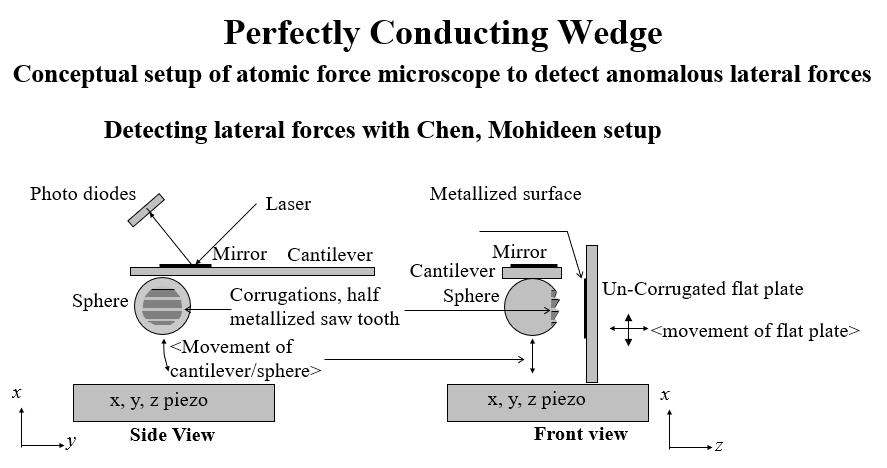
1) Quantum Fire Project 2) Tesla's Wireless Transmission of Electricity 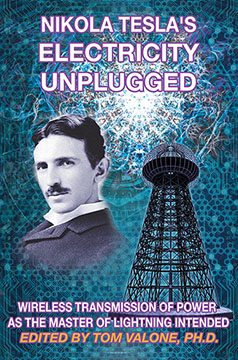
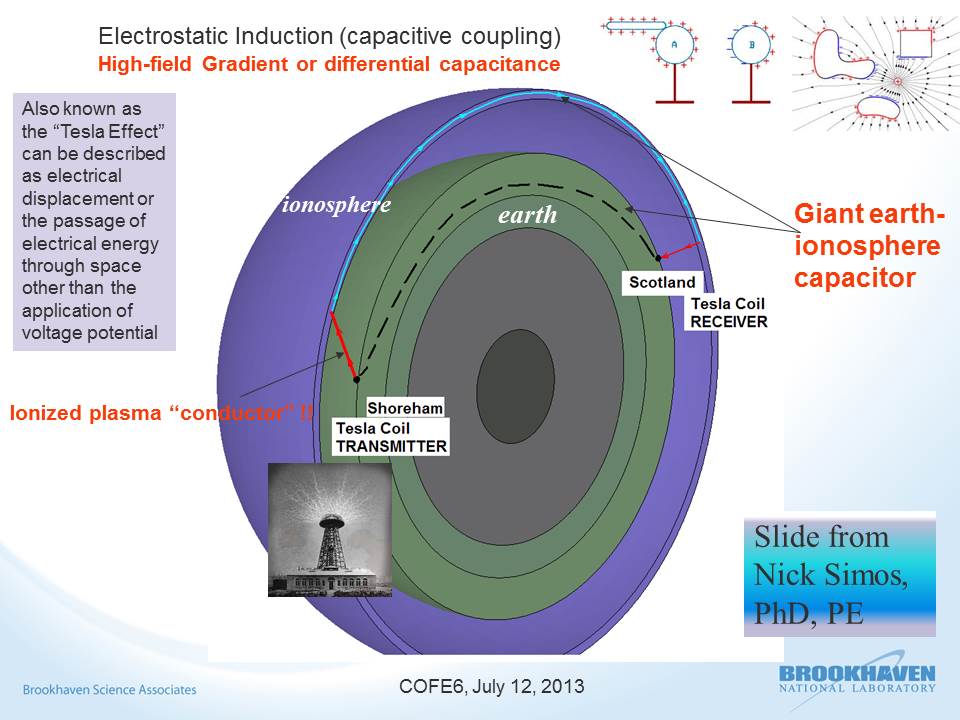
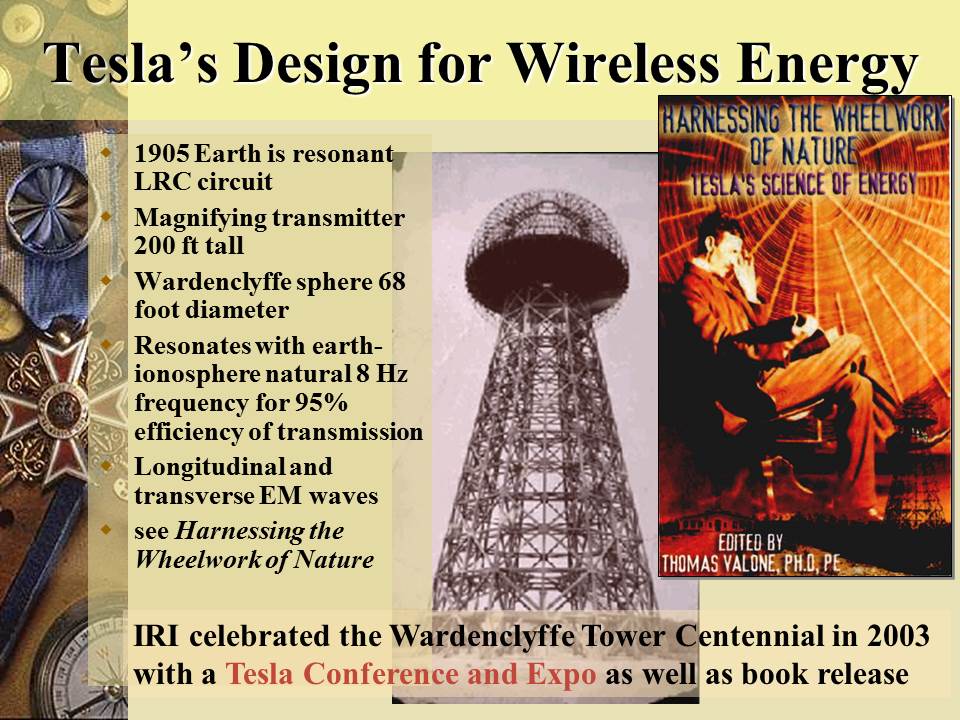
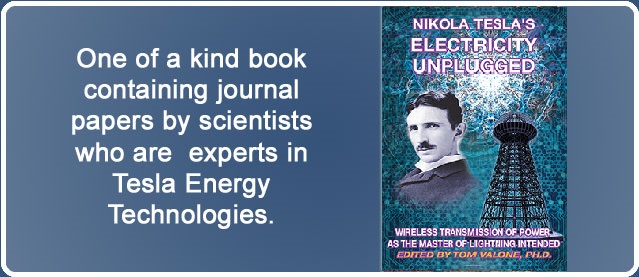
The second IRI project is the Wireless Transmission of Electrical Energy developed by Nikola Tesla in 1903 on Long Island and was called "Wardenclyffe". Interest in the validity of Tesla's physics has grown. In 2013, Dr. Nick Simos from Brookhaven National Labs gratiously presented his slideshow on the electromagnetic proof of Tesla's basic resonant transmission of energy through the earth-ionosphere cavity. See our Futurenergy.org webpage for the Flash video of his presentation and a link to all of his slides posted online. The book by Thomas Valone, Harnessing the Wheelwork of Nature: Tesla's Science of Energy is also a great resource for understanding the science behind this amazing 95% efficient transmission of energy worldwide, which can be accessed and used locally with a resonant receiver, as explained by Dr. Simos at COFE6 and COFE7. 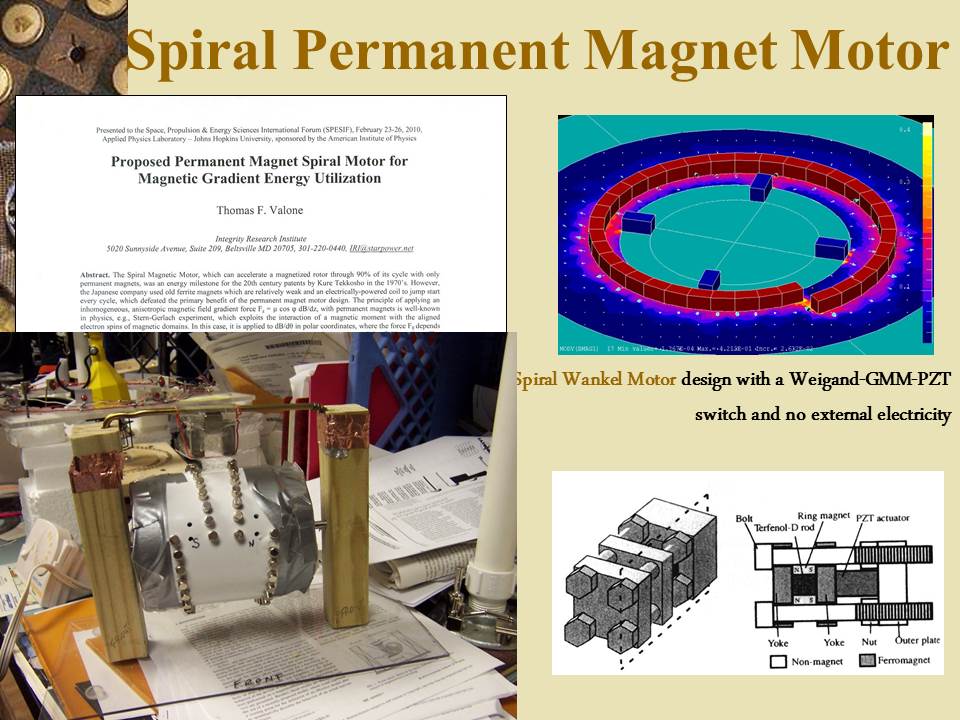
3) Spiral Magnetic Motor Project. Updating the Japanese "Permanent-Magnet Prime Mover" patents of the Kure Tekkosho company (e.g., Patent JP55144783), the Spiral Magnetic Motor is an interesting example of utilizing the magnetic gradient (see #1) in the circular path. The Sprain patent also demonstrates the public interest in such a magnetic motor. It also utilizes this spiral magnet design but defeats the purpose by including an externally powered magnetic coil pulse unit. The V-track design, with a piezoelectric stator magnet, may result in "the world's first fuelless magnetic engine". Such a topic was presented in Future Energy eNews, September 8, 2004. Recently updated with the V-Track design and a successful Indegogo crowd-funding campaign, this invention is explained in detail in the a peer-reviewed journal paper by Dr. Valone on the "Proposed Permanent Magnetic Spiral Motor for Magnetic Gradient Utilization" in the Proceedings of SPESIF 2010, an American Institute of Physics publication. 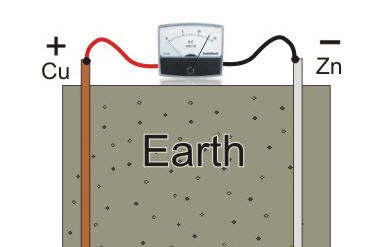
4) DIY Batteries that Last Forever 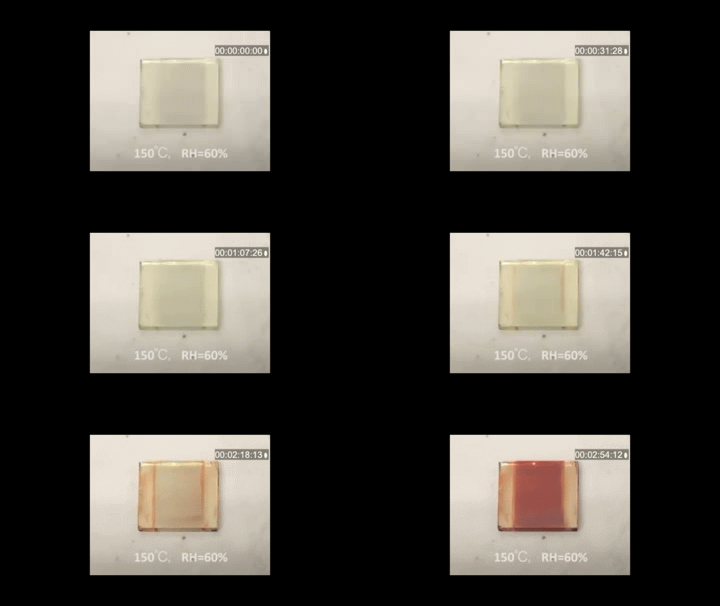
5)Scientists Discover Ideal Material for Smart PVs 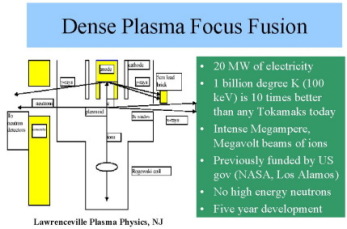
6) Proton-Boron (p-B11) Fusion 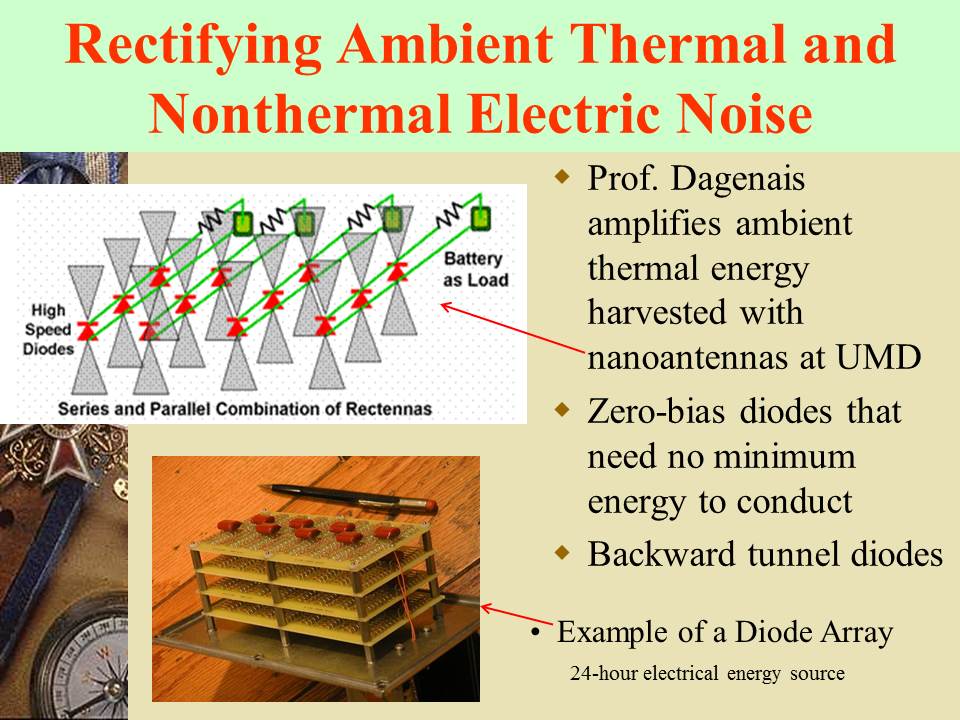
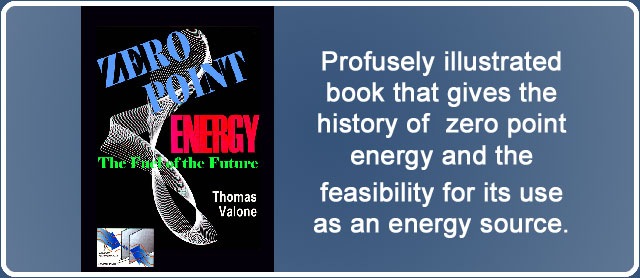
7) Also on our list is the thermal and nonthermal energy rectification using tunnel diodes or backward tunnel diodes. Prof. Dagenais from the U of Maryland amplifies ambient thermal energy harvested with nanoantennas at UMD. A peer-reviewed published paper (PDF) was published by Dr. Valone (SPESIF, 2009) entitled, "Proposed Use of Zero Bias Diodes as Thermal Electric Noise Rectifiers and Non-Thermal Energy Converters". There is also a wonderful slideshow (PDF) on Diode Energy Array Converters by Thomas Valone explaining the basic principles online. Zero-bias diodes are diodes that need no minimum energy to conduct so they are as good as backward tunnel diodes to convert ambient thermal oscillations of electrons into useful electricity. More information is also contained in the book by Dr. Valone, Zero Point Energy: the Fuel of the Future 
8) A device based on a 155-year-old thought experiment has been realised at the largest scale yet, published in New Scientist magazine, and it may help us understand how entropy, or disorder, is produced. It could also someday be used to harvest energy from motion...The electricity to power the shaker is far more than what can be gotten back from the rotor's motion, but it's not hard to imagine a situation where the shaking is provided naturally, such as in a river or on a bridge people are crossing. "If you have to pay to create this fluctuating environment, then of course it doesn't work, you can't get around the second law of thermodynamics," says John Bechhoefer at Simon Fraser University in Canada, who was not involved in this work. "But if someone else gives you this fluctuating environment and you don't have to pay for it, then it could make sense." This experiment produced only about 4 microwatts of power, tiny compared to the 10 watts required to keep the beads shaking. If this engine could be made larger and the shaking provided for free, the researchers say it could potentially be used to harvest energy from its environment. The original journal article has been archived on our IRI website for you. IF YOU ENJOYED THE ABOVE SAMPLE of our Future Energy eNews, please take advantage of a FREE monthly subscription emailed to you! The monthly FE eNews, edited by Dr. Tom Valone, is hosted by award-winning Constant Contact. CLICK HERE to subscribe to Future Energy eNews. Unsubscribe anytime. Other Future Energy Resource Materials Nuclear waste treatment that works: Laser-Driven Photo-Transmutation of Nuclear Waste journal article from J. Phys. D, 2003 The Future Energy position paper (1999) summarizes the advanced energy inventions presented at COFE. A Review of the Conference on Future Energy (COFE) is available online. |
|
 |
|




Integrity Research Institute
Designed by Jayson Abate